In knitwear factory, a successful bulk order does not begin on the production line. It begins much earlier — with a well-developed sample.
Garment sampling is one of the most important steps in the clothing production process. It allows brands, designers, and manufacturers to confirm the design, fit, fabric performance, workmanship, and production feasibility before moving into mass production. For professional clothing manufacturers, sampling is not just about making one piece of clothing. It is a quality control process, a communication tool, and a foundation for stable production.
1. Knitwear Factory Sampling Helps Turn a Design Idea into a Real Product
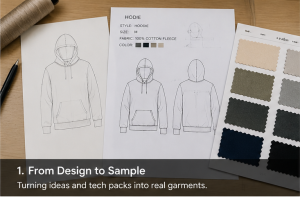
Many clothing projects start with a design sketch, reference photo, tech pack, or buyer concept. However, a design on paper does not always translate directly into a finished garment.
During the sampling stage, the manufacturer checks whether the design can be produced correctly based on the selected fabric, pattern structure, sewing method, trims, and finishing requirements. This process helps identify potential issues early, such as unsuitable fabric weight, incorrect construction, poor fit, or complicated workmanship that may affect production efficiency.
A professional sample allows both the buyer and the factory to see the real product before bulk production begins.
2.Knitwear Factory Sampling Confirms Fabric, Fit, and Garment Structure
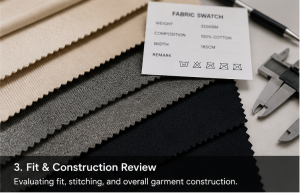
Fabric choice has a major impact on the final garment. Even when two fabrics look similar, they may perform differently in terms of stretch, shrinkage, drape, thickness, and hand feel.
Through sampling, the factory can test how the fabric works with the garment design. For knitted garments, this may include checking elasticity, recovery, seam stability, and overall comfort. For woven garments, the focus may be on structure, shape retention, seam strength, and ironing performance.
Fit is another key point. A sample helps confirm measurements, proportions, and wearing comfort. If adjustments are needed, they can be made before bulk production, reducing the risk of size inconsistency or customer complaints later.
3. Knitwear Factory Sampling Improves Communication Between Buyer and Factory
In international apparel manufacturing, clear communication is essential. Buyers may have specific expectations for fabric, stitching, labels, packaging, measurements, and finishing details. A physical sample helps both sides confirm these requirements more accurately than written descriptions alone.
When reviewing a sample, the buyer can provide comments on fit, workmanship, color, fabric hand feel, or design details. The factory can then make corrections and prepare a revised sample if needed.
This process helps reduce misunderstandings and ensures that both parties have the same production standard before the order moves forward.
4. Knitwear Factory Sampling Reduces Risk in Bulk Production
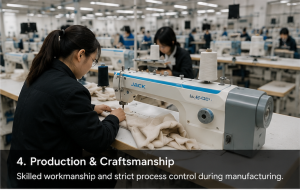
Bulk production involves material purchasing, production scheduling, labor arrangement, quality inspection, and delivery planning. Once production starts, correcting mistakes can be costly and time-consuming.
A confirmed sample works as a reference standard for the entire production process. The production team, quality control team, and finishing team can all follow the approved sample to maintain consistency.
This helps reduce risks such as incorrect measurements, wrong stitching methods, poor finishing, fabric defects, and packaging mistakes. For buyers, this means better product consistency and more reliable delivery.
5. Sampling Reflects a Factory’s Professional Capability
For a clothing manufacturer, the sampling process shows more than technical sewing ability. It reflects the factory’s understanding of product development, quality control, material behavior, and customer requirements.
A professional factory should be able to review the buyer’s requirements, suggest suitable production methods, identify potential risks, and provide practical solutions. Good sampling is not only about following instructions, but also about helping customers improve product quality and production efficiency.
This is especially important for OEM and ODM apparel projects, where buyers expect the factory to support development from concept to finished product.
Conclusion
Garment sampling is a small step compared with bulk production, but it plays a major role in the success of an apparel order. It helps confirm design, fit, fabric, workmanship, and production details before mass manufacturing begins.
For brands looking for a reliable clothing manufacturer, choosing a factory with strong sampling capability can reduce production risks, improve product quality, and make the entire development process more efficient.
A well-made sample is not just a preview of the final garment — it is the foundation of successful apparel production.
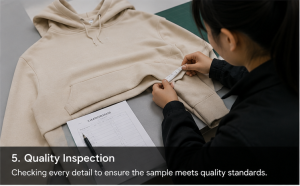
cardigan knit factory, pullovers factory, knit pants factory, knit vest factory, knit turtleneck factory, knit skirt factory, knit dress factory all rely heavily on professional garment sampling before bulk knitwear production, as sampling turns design sketches into wearable knit pieces and eliminates costly manufacturing errors for fashion OEM and ODM brands. Many knit apparel brands cooperate with a knit factory but skip strict sampling, which often leads to ill-fitting knit cardigans, uneven pullover fabric, flawed knit pants or inconsistent knit dresses after mass production. High-quality sampling is the most critical pre-production step for every knitwear factory to stabilize fabric, fit, stitching and finished garment quality.