Understanding MOQ in Custom Knitwear Manufacturing: A Practical Guide for Fashion Brands
Minimum order quantity, commonly known as MOQ, is one of the first topics discussed when a fashion brand begins working with a custom knitwear manufacturer.
For emerging labels, a high MOQ may create inventory pressure and increase financial risk. For manufacturers, however, producing very small quantities can lead to higher material, programming, sampling, and production costs.
Understanding how knitwear MOQ works can help brands plan collections more effectively, control costs, and build a more efficient relationship with their manufacturing partner.
What Does MOQ Mean in Knitwear Manufacturing?
MOQ refers to the smallest number of units a manufacturer is willing or able to produce for a particular order.
In custom knitwear manufacturing, MOQ may be calculated in several ways:
Per style
Per color
Per size
Per yarn type
Per order
Per production technique
For example, a manufacturer may accept 100 pieces per style but require at least 30 pieces in each color. Another supplier may calculate the MOQ according to the amount of yarn that must be purchased from the yarn mill.
This is why brands should not only ask, “What is your MOQ?” They should also ask how the MOQ is structured.
Why Do Knitwear Manufacturers Set Minimum Order Quantities?
Unlike purchasing ready-made garments from stock, custom knitwear production involves several preparation stages before bulk manufacturing can begin.
These may include:
Yarn sourcing
Yarn color matching or dyeing
Knitting program development
Machine setup
Panel testing
Measurement adjustment
Washing trials
Linking and finishing setup
Quality control preparation
These processes require time and technical resources regardless of whether the final order contains 50 pieces or 500 pieces.
A reasonable MOQ allows the manufacturer to distribute these setup costs across the production order. When the quantity is extremely low, the cost per garment may increase significantly.
Key Factors That Affect Custom Knitwear MOQ
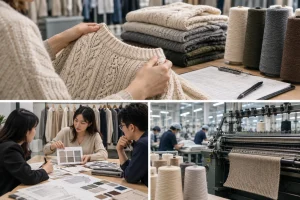
There is no universal MOQ that applies to every knitwear project. The required quantity depends on the product design, materials, construction, and factory capabilities.
- Yarn Availability
Yarn is one of the most important factors influencing MOQ.
If a brand selects a standard stock yarn and an available color, the manufacturer may be able to offer a lower MOQ. If the project requires a custom-dyed shade, specialty blend, or uncommon yarn count, the yarn supplier may impose its own minimum purchase requirement.
This can make a small garment order difficult to produce economically.
Brands seeking lower quantities should consider selecting yarns from the manufacturer’s existing shade cards or stock programs.
- Number of Colors
Adding more colors divides the total order into smaller production batches.
For example, an order of 200 sweaters in one color is usually easier to manage than an order of 200 sweaters divided across five colors. Each additional color may require separate yarn preparation, machine setup, production tracking, and quality inspection.
Reducing the number of colors in the first order can help brands reach MOQ requirements while keeping inventory manageable.
- Design Complexity
Simple knitwear designs generally allow more production flexibility.
Complex details such as jacquard patterns, intarsia graphics, engineered stripes, cables, special stitches, embroidery, and custom trims may require additional programming and setup.
The manufacturer must also spend more time testing the structure and ensuring the design remains stable after washing.
As a result, technically complicated garments may carry a higher MOQ or a higher unit price.
- Knitting Gauge
Different garments require different knitting machines.
Fine-gauge sweaters, heavy-gauge cardigans, ribbed garments, and fully fashioned products may each need specific equipment. Machine availability and production efficiency can therefore influence the minimum quantity.
A manufacturer specializing in the required gauge may be more flexible than a supplier that must make significant adjustments to accommodate the product.
- Size Range
A wide size range can create additional challenges for small orders.
Every size requires grading, measurement control, and production planning. When only a few pieces are ordered in each size, manufacturing efficiency decreases.
For a first collection, brands may benefit from starting with a focused size range based on their target customer data.
- Trims and Accessories
Custom buttons, zippers, labels, packaging, metal accessories, and other trims often have separate supplier MOQs.
Even when the knitwear factory accepts a low garment quantity, the trim supplier may require a much larger order. This can leave the brand with unused accessories or increase the total development cost.
Using standard trims for an initial order can provide more flexibility.
Is Low-MOQ Knitwear Production Possible?
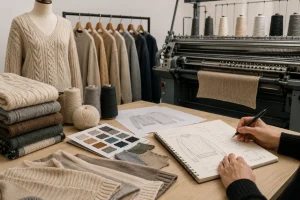
Low-MOQ production is possible, but brands should expect certain trade-offs.
A manufacturer may support smaller orders by offering:
Stock yarns and available colors
Standard size ranges
Simple knitting structures
Existing button and trim options
Fewer colorways
Combined production with similar orders
A higher unit price
A separate setup or programming fee
Low MOQ does not always mean low total cost. The development and setup work remains necessary, so the cost per garment is often higher than it would be for a larger production run.
Brands should compare the total financial risk rather than focusing only on the unit price. Paying slightly more per piece may be reasonable if it prevents excess inventory.
How Can Fashion Brands Reduce MOQ Pressure?
There are several practical ways to make a smaller knitwear order more suitable for production.
Use the Same Yarn Across Multiple Styles
A brand may develop a sweater, cardigan, and knitted vest using the same yarn and color palette.
This allows the manufacturer to purchase a larger total volume of yarn while dividing it across several designs. It can also create a more consistent collection.
Limit the Number of Initial Colorways
Instead of launching every design in four or five colors, brands can begin with one or two commercially strong shades.
Additional colors can be introduced after sales data becomes available.
Choose Available Yarn Colors
Custom dyeing can increase both MOQ and lead time. Selecting colors from an existing yarn shade card can make smaller production runs more achievable.
Simplify the First Production
A first order is an opportunity to evaluate product quality, customer response, sizing, and supplier performance.
Starting with a manageable design can reduce production risk. More complex techniques can be introduced after the brand and manufacturer have established a stable workflow.
Consolidate Orders
Placing several small orders separately may be less efficient than planning one coordinated production schedule.
Combining styles that use similar yarns, gauges, or trims may help the manufacturer organize materials and machine time more effectively.
Discuss Future Order Potential
Manufacturers may be more flexible when they understand the brand’s long-term plans.
Providing a realistic product roadmap, estimated annual quantity, and expected reorder schedule can support a more constructive MOQ discussion. However, brands should avoid making volume promises they cannot confidently meet.
Questions to Ask a Knitwear Manufacturer About MOQ
Before confirming an order, brands should clarify the following points:
- Is the MOQ calculated per style, color, size, or total order?
- Does the selected yarn have a separate minimum quantity?
- Can stock yarns or available colors reduce the MOQ?
- Are sampling and programming fees included in the quotation?
- Will the unit price change at different quantity levels?
- Do custom trims have separate minimum quantities?
- Can multiple styles share the same yarn purchase?
- Is repeat production possible using leftover yarn?
- What happens if the final quantity falls below the agreed MOQ?
- How will unused yarn or trims be handled?
Clear answers to these questions can prevent unexpected costs later in the production process.
Finding the Right Balance Between MOQ and Cost
The lowest MOQ is not always the best option, just as the lowest unit price is not always the most economical choice.
A successful production plan balances several factors:
Available budget
Expected sales volume
Product complexity
Inventory risk
Target retail price
Delivery schedule
Reorder potential
An experienced custom knitwear manufacturer should be able to explain how different design and quantity decisions affect the final cost.
Rather than treating MOQ as a fixed obstacle, brands can use it as part of the product-development process. Adjusting yarn selection, color quantity, construction, or trims may create a production plan that works for both parties.
Final Thoughts
MOQ plays an important role in custom knitwear manufacturing because every order requires material preparation, technical development, machine setup, and quality control.
For fashion brands, the goal should not simply be to find the lowest possible MOQ. The goal is to develop a realistic order structure that protects cash flow while maintaining product quality and production efficiency.
By selecting suitable yarns, limiting unnecessary variations, consolidating materials, and communicating openly with the manufacturer, brands can reduce MOQ pressure and build a more sustainable production strategy.
A reliable knitwear manufacturing partner will not only provide a number. They will help the brand understand what drives that number and identify practical ways to optimize the order.