When contacting a knitwear manufacturer for the first time, one of the most common questions is simple: What information should I send to get a quotation?
For fashion brands, designers, retailers, and sourcing companies, obtaining a price may seem straightforward. You send a sweater design, the factory checks it, and then provides a unit price.
In reality, custom knitwear pricing depends on many details.
Two sweaters that look similar in a photograph can have very different production costs depending on the yarn composition, garment weight, gauge, knitting structure, size specifications, order quantity, trims, finishing, and packaging requirements.
The more information a manufacturer receives at the beginning, the more accurately it can evaluate the design and calculate the cost.
A clear inquiry also reduces repeated questions and helps both sides move more quickly toward sampling and production.
So, what should you prepare before requesting a custom knitwear quotation?
1. Product Sketch, Tech Pack, or Reference Image
The first thing a knitwear manufacturer needs is a clear understanding of the product you want to make.
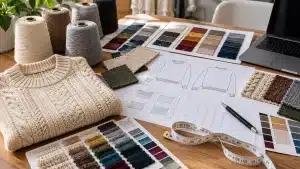
The best starting point is usually a tech pack containing technical drawings and product specifications.
A complete tech pack may include:
- Front and back garment sketches
- Construction details
- Measurements
- Yarn information
- Knit structures
- Colors
- Artwork
- Trims
- Labels
- Packaging instructions
However, not every brand has a complete tech pack when making the first inquiry.
If you are still in the early development stage, you can also provide a design sketch, a reference garment, a photograph, an inspiration image, or an existing product that you want to modify.
For example, you may send a reference sweater and explain that you want a similar silhouette but with a different neckline, yarn composition, sleeve shape, or knit pattern.
The manufacturer can then evaluate the design and identify which technical details still need to be confirmed.
A reference image alone may be enough for an initial discussion, but additional information will usually be required before a final production quotation can be confirmed.
2. Yarn Composition and Material Requirements
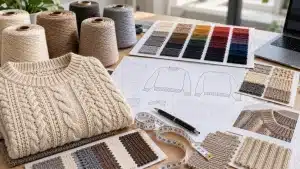
Yarn is one of the most important cost factors in knitwear manufacturing.
Different fibers can create significant differences in both price and product performance.
Common knitwear materials include:
- Cashmere
- Merino wool
- Wool
- Cotton
- Acrylic
- Viscose
- Polyester
- Nylon
- Recycled fibers
- Blended yarns
For example, a 100% cashmere sweater and an acrylic-blend sweater may have a similar appearance in a photograph, but their material costs and market positioning are completely different.
When requesting a quotation, provide your preferred fiber composition whenever possible. For example: 100% Merino wool, or 50% viscose / 28% polyester / 22% nylon.
If you have not decided on the exact composition, explain the product objective instead. You might tell the manufacturer that you need a soft premium yarn for an autumn collection, a breathable cotton-based yarn for spring and summer, a cost-effective yarn for a commercial retail program, a lightweight yarn with good drape, or a warm yarn for a chunky winter sweater.
Providing the expected hand feel, season, positioning, and target price allows the manufacturer to recommend more suitable yarn options.
It is also helpful to mention whether you require stock yarn or a custom-developed color. Stock yarn may simplify sourcing for smaller orders, while custom yarn or custom dyeing can involve additional minimum quantities and development time.
3. Gauge and Knitting Structure
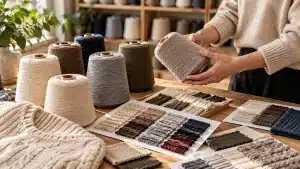
Gauge has a major influence on the appearance, weight, hand feel, and manufacturing cost of knitwear.
In general, lower-gauge knitting creates a heavier and chunkier appearance, while higher-gauge knitting produces a finer and lighter fabric.
If the gauge has already been defined in your technical specification, include it in your inquiry.
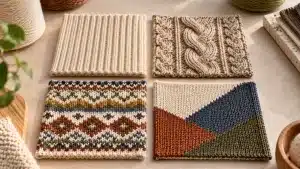
You should also provide information about the required knit structure or technique. Examples include:
- Jersey knit
- Rib knit
- Cable knit
- Jacquard
- Intarsia
- Pointelle
- Mesh or openwork
- Fully fashioned construction
- Special textured stitches
Complex knit structures may require additional programming, yarn preparation, machine time, or manual work.
For jacquard and intarsia products, the number of colors and the complexity of the artwork can also influence production cost.
If you do not know the technical name of a particular stitch, a close-up photograph or physical reference can be very useful. An experienced knitwear manufacturer can review the visual effect and recommend a suitable knitting method.
4. Size Chart and Garment Measurements
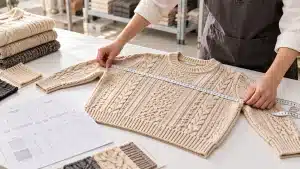
Size and garment measurements affect both product development and yarn consumption.
Whenever possible, send a size chart with the quotation request.
Important measurements may include:
- Chest width
- Body length
- Shoulder width
- Sleeve length
- Armhole
- Neck opening
- Hem width
- Cuff width
For an oversized sweater, for example, the garment may require considerably more yarn than a fitted sweater made from the same material. This means that silhouette and measurements can directly influence the unit price.
If the product will be offered in several sizes, provide the expected size range, such as XS-XL or S / M / L.
If you currently have only one base size, the factory can first review the quotation based on that size and discuss grading requirements during development.
It is also useful to explain the intended fit, such as slim, regular, relaxed, cropped, or oversized.
For knitwear, measurements cannot always be evaluated independently from yarn and knitting structure. Stretch, garment weight, washing, finishing, and knit density can all influence the final dimensions and fit.
5. Colors and Artwork
Color requirements should be included as early as possible.
For standard colors, you may simply provide the required color names together with visual references.
For more precise color matching, brands commonly provide:
- Pantone references
- Physical fabric swatches
- Yarn swatches
- Existing garments
- Brand color standards
If the design includes jacquard, intarsia, embroidery, printing, or another decorative element, send the artwork together with the inquiry.
Ideally, artwork should show exact placement, dimensions, number of colors, required technique, and logo or motif details.
For example, a simple one-color embroidered logo and a large multi-color jacquard graphic require completely different manufacturing processes.
This information allows the manufacturer to evaluate the technical requirements before calculating the price.
For custom colors, it is also important to understand that the final appearance may vary depending on yarn composition. Wool, cotton, viscose, acrylic, polyester, and blended yarns respond differently to dyeing and can produce slightly different visual results.
6. Order Quantity and Quantity per Color
Quantity is essential for any meaningful quotation.
Instead of writing only “Please quote this sweater,” provide an estimated order quantity.
For example: 500 pieces total. Even better, provide the quantity by color: Black: 200 pcs; Cream: 150 pcs; Grey: 150 pcs.
If several sizes are involved and the size breakdown is available, this can also be shared.
The manufacturer needs quantity information because it affects yarn purchasing, material MOQ, machine scheduling, production efficiency, trims, packaging, and unit cost.
A quotation for 100 pieces may therefore be different from a quotation for 1,000 pieces of the same design.
Color quantity is particularly important when custom-dyed yarn is required. A yarn supplier may have its own minimum quantity for each custom color.
If your final quantity has not yet been confirmed, provide an estimated range, such as 300-500 pieces per style, or request prices at different quantity levels.
7. Trims, Labels, and Special Details
Small details can make a significant difference to the final cost.
If your design includes special accessories or branding elements, include them in the quotation request.
These may include:
- Buttons
- Zippers
- Metal accessories
- Drawcords
- Patches
- Embroidery
- Beads or sequins
- Custom neck labels
- Size labels
- Care labels
- Hangtags
For custom buttons, metal trims, patches, or other accessories, send photographs, dimensions, material requirements, and artwork whenever available.
If you plan to supply certain trims yourself, tell the manufacturer in advance. Otherwise, the factory may assume that these components need to be sourced and include them in the quotation.
The same applies to branding. A basic standard label and a fully customized branding package have different costs, so defining these requirements early helps avoid price changes later.
8. Packaging Requirements
Packaging is sometimes forgotten during the initial quotation stage, but it is part of the final product cost.
Tell the manufacturer whether you require:
- Individual polybags
- Custom printed bags
- Tissue paper
- Barcode stickers
- Size stickers
- Hangtags
- Carton markings
- Custom boxes
- Special folding methods
Retailers and established fashion brands may also have their own packaging manuals or supplier requirements.
If these are available, sending them at the quotation stage allows the manufacturer to understand the full project rather than quoting only the garment itself.
If you do not have special requirements, standard export packaging can normally be discussed with the supplier.
9. Target Price
Some buyers are hesitant to disclose their target price. However, providing a realistic target can actually make product development more efficient.
A knitwear design can often be produced in several ways.
For example, if the original specification is above your target cost, the manufacturer may be able to suggest alternatives such as a different yarn composition, a stock yarn instead of custom-dyed yarn, a simplified knit structure, a different gauge, an alternative trim, or a more production-efficient construction.
The objective is not necessarily to make the product as cheap as possible. The objective is to develop a product that achieves the required balance between appearance, quality, performance, and commercial price.
For this reason, it can be helpful to provide both the target product positioning and the expected purchase price. For example: Target market: mid-range womenswear brand; Target FOB price: approximately USD XX.
10. Required Delivery Date
Your expected delivery schedule should also be included in the inquiry.
Custom knitwear involves several stages before shipment, including design review, yarn sourcing, sample development, approvals, bulk production, finishing, inspection, packing, and transportation.
If you are working toward a fixed collection launch or retail delivery date, tell the manufacturer as early as possible.
For example: Required ex-factory date: March 15; or Goods need to arrive in Germany before April 20.
These two requirements are not the same. An ex-factory date refers to when goods leave the manufacturer, while an arrival date must also consider international transportation and customs clearance.
Providing a clear deadline allows the manufacturer to evaluate whether there is enough time for sampling, material preparation, production, and shipment.
It can also help determine whether stock yarn, custom dyeing, special trims, or complicated techniques are practical within the available schedule.
11. Destination Market and Testing Requirements
For some projects, it is useful to tell the manufacturer where the garments will be sold.
Different customers, retailers, and markets may have specific requirements regarding fiber composition labeling, care labels, country-of-origin information, product testing, packaging, chemical restrictions, and performance standards.
If your company has a testing manual or specific quality requirements, sending them early can prevent unexpected additional costs later.
Testing may include areas such as shrinkage, colorfastness, pilling, dimensional stability, or fiber composition.
If third-party laboratory testing is required before shipment, this should also be discussed when planning the cost and production schedule.
What If You Do Not Have a Tech Pack?
Not every custom knitwear project begins with complete technical information.
Emerging brands, designers, and buyers may initially have only a sketch, photograph, reference garment, or general product idea.
You can still contact a manufacturer. In this situation, provide as much information as you currently have.
For example: Product: Women’s oversized cardigan; Reference: Attached image; Material: Soft wool blend, composition open to suggestion; Color: Cream and dark grey; Quantity: Approximately 300 pcs per color; Target price: USD XX; Delivery: Before September; Market: Europe.
This information already gives the manufacturer a useful starting point.
The factory can then help clarify questions such as which yarn is suitable, which gauge should be used, how the knit structure can be produced, whether the design is technically feasible, whether the target quantity meets material MOQ, and what information is still needed before sampling.
A professional knitwear manufacturer should not simply provide a number. It should also help identify unclear specifications that could affect cost, appearance, quality, or production feasibility.
Why Complete Information Leads to a Better Quotation
A quotation is only as accurate as the information used to calculate it.
When specifications are incomplete, the manufacturer may need to make assumptions about yarn, measurements, construction, trims, or packaging. If these assumptions later change, the price may also need to change.
For example, an initial quotation based on a standard acrylic blend cannot remain the same if the final product is changed to 100% Merino wool.
Similarly, adding custom buttons, embroidery, a larger oversized fit, or special packaging after the quotation may increase the final production cost.
Providing clear information from the beginning therefore helps brands receive more accurate prices, compare suppliers more fairly, reduce repeated communication, identify technical problems earlier, shorten the development process, reduce unexpected price changes, and plan sampling and production more efficiently.
The purpose of a quotation should not simply be to obtain the lowest number. It should provide a realistic understanding of what the specified product will cost to manufacture.
A Simple Knitwear Quotation Checklist
Before sending your next inquiry, check whether you can provide the following information:
Product information
- Tech pack, sketch, reference image, or sample
- Product type and intended fit
- Size chart or key measurements
Material and construction
- Yarn composition
- Gauge
- Knit structure
- Special techniques
Design details
- Colors
- Pantone references
- Artwork
- Logo placement
- Trims and accessories
Commercial information
- Total order quantity
- Quantity per color
- Target price
- Required delivery date
- Destination market
Branding and packing
- Neck label
- Care label
- Hangtag
- Packaging requirements
- Testing requirements
You do not necessarily need every item before making first contact. However, the more information you can provide, the faster the manufacturer can understand the project and prepare a useful quotation.
How Tesin Supports Knitwear Quotation and Product Development
At Tesin Knitwear, we work with fashion brands, retailers, sourcing companies, private labels, and designers on custom knitwear development.
Projects can begin from different stages. Some customers send complete tech packs with detailed measurements, yarn specifications, artwork, and packaging instructions. Others begin with design sketches, reference garments, or inspiration images.
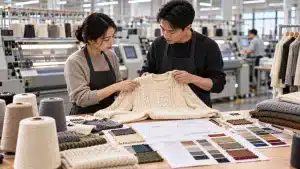
Our team reviews the available information and helps identify the technical details needed for development and quotation.
Depending on the project, this may include reviewing yarn and material options, gauge and knitting structures, size and fit, colors, jacquard and intarsia artwork, embroidery and decorative details, trims and labels, order quantity and MOQ, production feasibility, and packaging requirements.
By clarifying these details early, brands can move from initial concept to sampling and bulk production with a clearer understanding of cost and technical requirements.
Conclusion: Better Information Creates Better Quotations
When requesting a quotation from a knitwear manufacturer, you do not need to prepare a perfect technical file before making contact.
But you should provide as much relevant information as possible.
At minimum, try to send a product reference, expected yarn or material direction, quantity, colors, size information, target price, and delivery requirement.
If a complete tech pack is available, include it. If it is not, a sketch, photograph, reference garment, or inspiration image can still start the conversation.
The manufacturer can then help identify the missing information and evaluate the most practical way to produce the design.
Clear communication at the quotation stage does more than help calculate a price. It creates a stronger foundation for sampling, material sourcing, production planning, quality control, and final delivery.
If you are developing a new knitwear collection, send Tesin your design, tech pack, reference image, quantity, material requirements, and target price. Our team can review the project and help you evaluate suitable yarns, knitting techniques, production feasibility, and quotation options.
Contact Tesin Knitwear to start your custom knitwear project.