Understand knitting gauges, compare sweater textures and weights, and choose the right construction for your next knitwear collection.
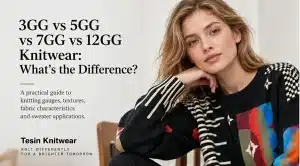
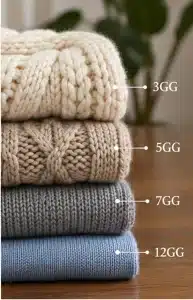
When shopping for sweaters or developing a new knitwear collection, you may come across technical terms such as 3GG, 5GG, 7GG, and 12GG. These numbers might seem confusing at first, but they play an important role in determining how a knitted garment looks, feels, and performs.
In the knitwear industry, “GG” refers to knitting gauge, which describes the number of needles per inch on a knitting machine. Different gauges create different knitting possibilities, influencing stitch size, surface texture, yarn selection, and the overall appearance of a garment.
Whether you are a fashion brand owner, clothing retailer, knitwear buyer, or someone who appreciates a well-made sweater, understanding these differences can help you make more informed decisions.
In this guide, we explore the characteristics of 3GG, 5GG, 7GG, and 12GG knitwear, compare their typical applications, and explain how to choose the right gauge for your next knitwear collection.
1. What Does GG Mean in Knitwear?
GG stands for gauge, a measurement of needle density on a knitting machine.
- 3GG:3 needles per inch
- 5GG:5 needles per inch
- 7GG:7 needles per inch
- 12GG:12 needles per inch
The basic principle is simple: lower gauge numbers indicate fewer needles per inch, while higher gauge numbers indicate more closely spaced needles.
Lower-gauge machines generally accommodate thicker yarns and create larger, more visible knitted loops. Higher-gauge machines typically work with finer yarns and produce smaller, more delicate-looking stitches.
However, knitting gauge is not the same as the finished garment’s measured stitch density. Yarn thickness, machine settings, knitting structure, and finishing processes can all affect the final result. Gauge is an important starting point rather than the only factor determining sweater thickness or quality.
2. Quick Comparison: 3GG vs 5GG vs 7GG vs 12GG
Before exploring each gauge individually, here is a comparison of their typical characteristics.
| Feature | 3GG | 5GG | 7GG | 12GG |
| Gauge category | Very chunky | Chunky | Medium | Fine |
| Stitch appearance | Large, prominent | Clearly visible | Moderately defined | Small, smooth |
| Typical fabric weight | Heavy | Medium-heavy | Medium | Light-medium |
| Common yarn choice | Thick yarns | Medium-thick yarns | Medium or finer yarns | Fine yarns |
| Typical texture | Bold, dimensional | Textured, structured | Balanced, versatile | Smooth, neat |
| Common season | Winter | Autumn / Winter | Autumn / Spring | Spring / Autumn |
| Popular applications | Chunky sweaters | Cable sweaters | Everyday sweaters | Lightweight pullovers |
Note: These descriptions are general industry guidelines. Actual weight, warmth, texture, and drape depend on yarn composition, knitting structure, and finishing.
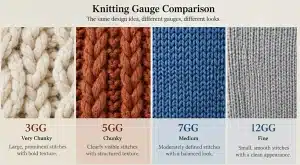
Each gauge has its advantages. The best choice depends on the intended design, target market, and wearing experience.
3. What Is 3GG Knitwear?
Bold, Chunky, and Full of Texture
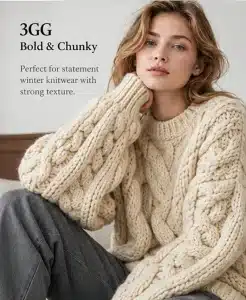
3GG knitwear belongs to the coarse-gauge category. With only three needles per inch, it is commonly associated with large stitches, thick yarns, and a distinctive chunky appearance. This gauge is particularly suitable for garments where the knitted structure itself is a major design feature.
Key Characteristics of 3GG Knitwear
Large, visible stitches. 3GG knitting creates opportunities for oversized loops and dramatic surface textures, making it well suited to statement sweaters and designs inspired by traditional hand knitting.
Substantial appearance. When combined with bulky yarn, 3GG fabrics often have considerable volume and a substantial feel.
Strong textural expression. Large cables, pronounced ribbing, and dimensional knitting patterns can become important visual elements.
Common Applications
- Oversized winter sweaters
- Chunky knitted cardigans
- Statement knitwear
- Heavy cable-knit pullovers
- Textured winter collections
Things to Consider
Although 3GG can create an appealing chunky look, garment weight and bulk require careful attention. Thick yarns and dense knitting structures may increase material consumption and finished weight. Designers should also consider neckline stability, shoulder construction, and the way the garment hangs on the body.
Best for: Brands seeking bold winter knitwear with prominent textures and oversized silhouettes.
4. What Is 5GG Knitwear?
Chunky Texture with Everyday Versatility
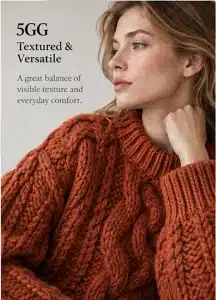
5GG knitwear offers a useful balance between substantial knitted texture and wearable flexibility. Compared with 3GG, the stitches are generally smaller and the fabric can appear more controlled. However, 5GG still provides enough visual definition for expressive knit structures.
Key Characteristics of 5GG Knitwear
Distinctive knitted texture. 5GG can highlight cable patterns, ribbed surfaces, and other decorative stitch structures.
Comfortable structure. Depending on the yarn and stitch construction, 5GG garments can offer a substantial feel while remaining suitable for everyday wear.
Design flexibility. This gauge supports a broad range of casual sweater styles, including relaxed pullovers and textured cardigans.
Common Applications
- Cable-knit sweaters
- Casual winter pullovers
- Knitted cardigans
- Textured crewneck sweaters
- Relaxed-fit knitwear
Why Brands Choose 5GG
For fashion brands developing autumn and winter collections, 5GG can provide a strong knitted identity without the extreme visual bulk associated with very coarse gauges. It also works well for designs in which fabric texture, color, and silhouette need to complement one another.
Two 5GG sweaters can still feel completely different. A lofty wool blend might produce a soft, voluminous garment, while a denser yarn could create a firmer and more structured result.
Best for: Autumn and winter sweaters combining visible texture, warmth, and everyday styling.
5. What Is 7GG Knitwear?
A Balanced Choice for Versatile Sweaters
7GG sits in the middle-gauge category and offers a practical balance between stitch definition and a more compact knitted surface. It is often considered for versatile sweaters that need to work across multiple styles, collections, and wearing occasions.
Key Characteristics of 7GG Knitwear
Balanced stitch appearance. 7GG stitches are generally smaller than those created with 3GG or 5GG machines. The surface can look more even while still retaining recognizable knitted texture.
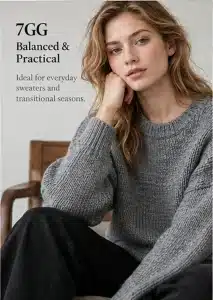
Versatile fabric construction. Depending on yarn selection and knitting settings, 7GG can create softer, more fluid garments or firmer, structured fabrics.
Broad design potential. It can accommodate various stitch patterns, selected cables, ribs, and colorwork designs.
Common Applications
- Everyday crewneck sweaters
- V-neck knitwear
- Casual cardigans
- Knitted polo sweaters
- Textured pullovers
- Transitional-season collections
Why 7GG Is Useful for Product Development
7GG provides flexibility when developing garments intended for different styling needs. A 7GG crewneck may work as a standalone sweater, while a cardigan in a suitable yarn and construction can become a practical layering piece.
Best for: Everyday sweaters, transitional-season knitwear, and collections requiring a balanced fabric appearance.
6. What Is 12GG Knitwear?
Fine Stitches and a Clean Appearance
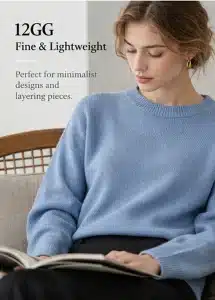
12GG is classified as fine-gauge knitting. With twelve needles per inch, it typically accommodates finer yarns and produces smaller, more closely spaced stitches. Compared with chunky knitwear, 12GG garments often have a smoother, flatter appearance.
Key Characteristics of 12GG Knitwear
Fine stitch definition. Small stitches create a neat surface that works well with understated garment designs.
Lightweight possibilities. When combined with suitable fine yarns, 12GG can produce relatively lightweight fabrics.
Comfortable layering. Fine-gauge sweaters can fit comfortably beneath coats, jackets, and other outerwear when developed with the appropriate thickness and silhouette.
Clean design expression. Smooth fabric surfaces can emphasize garment shape, neckline construction, and subtle details.
Common Applications
- Fine-knit crewneck sweaters
- Lightweight cardigans
- Knitted polo shirts
- Thin layering pullovers
- Minimalist knitwear
- Business-casual sweaters
Is 12GG Always Better Than Lower Gauges?
No. A higher gauge does not automatically mean better quality. A carefully developed 3GG sweater can demonstrate excellent yarn selection, construction, and finishing, just as a poorly executed 12GG sweater may have problems with fit or durability.
Best for: Lightweight knitwear, fine-textured sweaters, and clean, modern silhouettes.
7. 3GG vs 5GG vs 7GG vs 12GG: What Actually Changes?
Stitch Size and Surface Texture
Lower gauges generally create opportunities for larger, more prominent stitches. Higher gauges tend to support finer stitch structures. This means 3GG is usually more suitable for exaggerated textures, while 12GG works well for smooth and understated fabric surfaces.
Fabric Thickness and Weight
Chunky gauges are commonly paired with thicker yarns, so they often produce heavier garments. However, gauge alone does not determine garment weight. A densely constructed fabric may be heavier than expected, while a lofty yarn can create considerable volume without the same increase in weight.
Drape and Silhouette
Drape describes how fabric hangs and moves on the body. Chunky garments may create more volume and structure, while fine-gauge fabrics often allow softer, more fluid silhouettes. Yarn fiber, stitch length, and finishing can substantially change these characteristics.
Warmth and Comfort
It is tempting to assume that lower-gauge sweaters are always warmer. In practice, warmth also depends on fiber composition, fabric thickness, trapped air, density, and how the garment is worn.
Visual Design
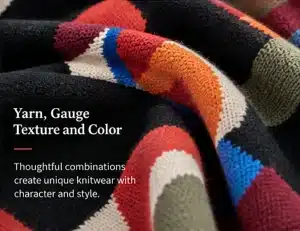
Coarse gauges can emphasize large cables, ribs, and oversized knitted details. Fine gauges can be effective for smooth surfaces, subtle textures, and smaller-scale patterns. For colorful geometric knitwear, the relationship between gauge, yarn, pattern scale, and knitting technique is particularly important.
8. How to Choose the Right Knitwear Gauge
Consider Your Target Season
For winter collections, 3GG and 5GG may be useful when the design calls for thick yarns and substantial textures. For transitional seasons, 7GG offers flexible development possibilities. For lightweight sweaters and layering pieces, 12GG can be a suitable starting point. These are general directions rather than fixed rules.
Match the Gauge to Your Design
If your collection features oversized cables and expressive knitted textures, consider 3GG or 5GG. If your design focuses on everyday versatility, 7GG may offer a suitable balance. If you want a smoother fabric surface with subtle detailing, 12GG is worth exploring.
Evaluate Yarn Selection
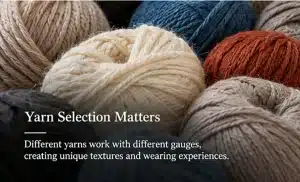
Different fibers and yarn constructions behave differently during knitting. Cotton, wool, cashmere, acrylic, viscose, and blended yarns can all influence softness, elasticity, drape, and appearance. Yarn count and the number of plies should also be discussed when selecting a suitable gauge.
Consider Your Target Customer
Think about how customers will wear the garment. Are they looking for a statement winter sweater, a comfortable everyday pullover, or a lightweight piece for office styling? The intended wearing occasion should guide gauge selection.
Request Fabric Samples
Before confirming a knitwear design, request development samples using the proposed yarn and knitting structure. Evaluate thickness, softness, elasticity, weight, appearance, and behavior after washing. Physical samples provide a more reliable basis for product decisions than gauge numbers alone.
9. Does Knitting Gauge Affect Sweater Quality and Price?
Knitting gauge can influence production planning and material requirements, but it does not independently determine quality or price. Several other factors are important:
- Yarn composition:Different fibers and blends have different material costs and performance characteristics.
- Yarn consumption:Garment dimensions, stitch structure, thickness, and knitting density influence the amount of yarn required.
- Design complexity:Cables, jacquard patterns, special stitches, and shaping details may require additional development and knitting time.
- Finishing requirements:Washing, blocking, linking, and inspection can influence the finished appearance and production process.
- Production quantity:Order volume, material availability, and design complexity can affect unit costs.
A fine-gauge sweater is not necessarily more expensive than a chunky sweater, and a chunky sweater is not necessarily more durable. Quality should be evaluated through material suitability, knitting consistency, garment construction, dimensional stability, and workmanship.
10. What Should Knitwear Buyers Confirm Before Production?
For clothing brands and sourcing teams, specifying gauge is only one part of developing a successful product. A clear knitwear specification should include:
- Machine gauge:Such as 3GG, 5GG, 7GG, or 12GG.
- Yarn composition:Fiber percentages and material requirements.
- Yarn count and ply:Details that affect yarn thickness and knitting suitability.
- Stitch construction:Jersey, rib, cable, jacquard, or another structure.
- Fabric density:The required knitted appearance and feel.
- Finished measurements:Garment dimensions and acceptable tolerances.
- Sample requirements:Reference samples and approval procedures.
- Testing expectations:Relevant wash, shrinkage, colorfastness, and durability requirements.
Evaluate how the garment performs after washing and finishing. A well-prepared specification helps reduce misunderstandings during product development and supports more consistent results.
11. Frequently Asked Questions About Knitwear Gauge
Is 3GG thicker than 12GG?
Typically, 3GG sweaters are designed with thicker yarns and larger stitches, while 12GG sweaters use finer yarns. However, final thickness depends on yarn selection and knitted construction, not machine gauge alone.
Which gauge is best for winter sweaters?
3GG and 5GG are common choices for chunky winter styles. Fiber composition, fabric density, and garment design should also be considered when evaluating warmth.
Is 7GG good for everyday knitwear?
Yes. 7GG is a versatile middle-gauge option for crewneck sweaters, cardigans, knitted polos, and other everyday styles.
Is 12GG knitwear always lightweight?
Not necessarily. Although 12GG is often used for lightweight designs, multiple yarn ends, dense structures, or layered constructions can create heavier fabrics.
Does a higher gauge mean better quality?
No. Gauge describes machine needle density rather than garment quality. Good knitwear depends on suitable yarns, consistent knitting, careful construction, and appropriate finishing.
Can the same sweater design be made in different gauges?
Often, yes, but adjustments may be necessary. Changing gauge can affect stitch dimensions, pattern proportions, yarn requirements, fit, and overall appearance. Sampling is essential.
12. Final Thoughts: Which Knitwear Gauge Should You Choose?
Understanding the differences between 3GG, 5GG, 7GG, and 12GG makes it easier to select knitwear that matches your design goals.
- 3GGis ideal for bold, chunky knitwear with prominent textures.
- 5GGoffers substantial knitted character with versatile styling possibilities.
- 7GGprovides a balanced option for everyday sweaters and transitional collections.
- 12GGsupports finer stitches, smoother surfaces, and lightweight designs.
There is no single gauge that works best for every sweater. The most successful knitwear combines an appropriate gauge with the right yarn, construction, silhouette, and finishing.
Explore Knitwear Possibilities with Tesin Knitwear
At Tesin Knitwear, we believe that thoughtful knitwear design starts with understanding the relationship between yarn, texture, comfort, and construction.
From expressive chunky sweaters to refined fine-gauge styles, every design choice contributes to a garment’s individual character. Whether you are exploring a new knitwear concept or refining an existing collection, understanding knitting gauge is an important step toward creating products that reflect your brand’s vision.
Explore knitwear inspiration with Tesin Knitwear and discover how thoughtful design brings texture, comfort, and individuality together.